Date published: November 24, 2026
More than 10,600 people now supported by Shared Lives as UK numbers rise 8% in a year
New national data shows renewed growth in Shared Lives, with 788 more people supported across the UK than a year ago.
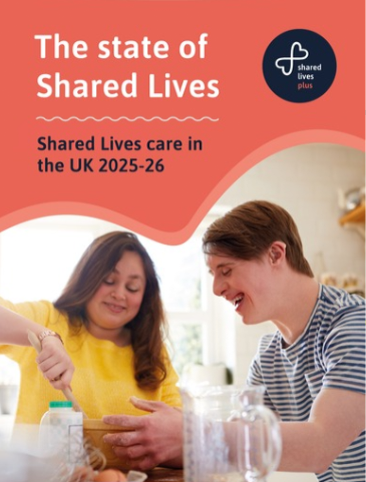
Our new State of Shared Lives 2025–26 report shows that Shared Lives supported 10,686 people across the UK this year – an increase of 8% on the previous year.
For the first time, we now have five years of national data on the number of people supported and Shared Lives carers. This gives us a clearer picture of how the sector is developing.
Ewan King, Chief Executive of Shared Lives Plus, said:
“Shared Lives shows what social care can look like when it starts with enduring relationships, connection and belonging. This report gives us real confidence that more people can benefit from that approach.
“The progress we are seeing has been built over time, through the work of Shared Lives carers, local schemes and the people they support. Our ambition now is to build on that momentum, so that Shared Lives is available to many more people as a genuine choice for how they live and are supported.
But we also know that growth remains difficult in many areas. We need a fairer deal for Shared Lives carers, strong local leadership and continued investment so that schemes have the capacity and support they need to develop and grow.”
A flexible model supporting a wide range of people
After a fall earlier in the five-year period, the number of people supported through Shared Lives has grown over the past two years and is now 3% higher than in 2021–22.
The number of registered Shared Lives carers has also grown over the longer term, rising by 14% since 2021–22 to 10,477 carers, with the strongest annual growth of 7% recorded in 2023–24.
People with a learning disability remain the largest group supported, with 6,771 people – 63% of the total. Shared Lives also supports autistic people, people experiencing mental ill health, older people and people with physical impairments.
Arrangements where people move into their Shared Lives carer’s home remain the most common form of Shared Lives, supporting 5,798 people. Short breaks increased by 6%, supporting 2,870 people, while day Shared Lives support saw the biggest increase, rising by 22% to 2,115 people.
This increase may reflect growing recognition of how Shared Lives can offer flexible support alongside wider care arrangements.
More young people leaving care supported through Shared Lives
Support for young people leaving foster or residential care has also continued to grow.
In 2025–26, 98 Shared Lives schemes supported young people leaving care and recorded 363 young people making the transition.
This is an increase of 3% on the previous year and 7% since 2023–24. Shared Lives has supported 714 care leavers across the past two years.
Shared Lives has also recently been named by the Department for Education as one of three proven models that local authorities can choose as part of their Staying Close offer for care-experienced young people in their area.
This is an emerging area for Shared Lives, alongside programmes such as Live More, a dementia pilot exploring how Shared Lives can support people living with dementia and their families to stay connected to the people, places and things they love.
While the national picture is encouraging, growth is not happening at the same pace everywhere. Some local schemes face significant pressures and do not yet have the capacity or support they need to grow.
Shared Lives Plus will continue to make the case for a fairer deal for Shared Lives carers and work with local areas to build the capacity, infrastructure and partnerships needed for sustainable growth.
